
GUIDES
How big should a calorie deficit be?
A step-by-step guide: your maintenance calories, the right deficit, the pace to expect and why it slows
What a calorie deficit is
A calorie is a unit of energy. Your body uses energy all day: to keep you alive at rest, to digest food and to move. When you eat less energy than you use, your body makes up the difference from its stores, mostly fat. That gap between what you eat and what you use is your calorie deficit. Every diet that leads to weight loss creates one, whether you count calories or not.
- Resting energy (BMR)
- The calories your body uses at complete rest, to breathe, pump blood and keep warm. Usually the biggest part of the total.
- Maintenance calories (TDEE)
- What you use in a whole day, with activity. Eat this much and your weight stays steady.
- Activity factor
- A multiplier, from about 1.2 for little exercise to 1.9 for very hard training, that turns resting energy into maintenance.
- Calorie deficit
- How far below maintenance you eat. 500 calories a day is a common target.
Step 1: find your maintenance calories
The calculator uses the Mifflin-St Jeor equation, published in 1990 in the American Journal of Clinical Nutrition from measurements of 498 healthy people 1. A review of the common equations by Frankenfield and colleagues found it the most reliable, though it can still be off by 10% or more for some people 4. Then it multiplies resting energy by your activity factor.
Step 2: choose your deficit
| Daily deficit | Weekly loss at first | Note |
|---|---|---|
| 250 kcal | About 0.25 kg (½ lb) | Easy to keep up |
| 500 kcal | About 0.5 kg (1 lb) | The usual recommendation |
| 750 kcal | About 0.75 kg (1.5 lb) | Harder; more protein matters |
| 1,000 kcal or more | About 1 kg (2 lb) | Only with medical guidance |
Then check reality: weigh yourself a few times a week, at the same time of day, and compare weekly averages. If your average hasn’t moved after three weeks, eat about 100 to 200 calories less; if you’re losing faster than 1% of your body weight a week, eat a little more.
Why weight loss slows
As you lose weight, your body needs fewer calories, so the same intake gives a smaller deficit and your weight loss slows. Kevin Hall and colleagues showed in The Lancet in 2011 that this is why the old rule, that cutting 3,500 calories always means a pound of fat lost, overestimates long-term results 2. It doesn’t mean your diet stopped working: recalculate your maintenance every 5 kg (10 lb) or so.
Your body pushes back
Key study
Hunger hormones stay changed for a year
- Clinical study
- 50 adults with overweight
- 62 weeks
After a 10-week very low-calorie diet, the hormones that signal hunger and fullness were still changed a year later, in the direction that increases appetite: ghrelin, which drives hunger, was higher, and leptin, which signals fullness, was lower. People reported feeling hungrier than before they lost weight.
In an extreme case, contestants of a televised weight-loss competition who lost weight very fast burned about 500 calories a day less than expected for their size six years later, and most regained much of the weight 6. Moderate deficits, enough protein and strength training help limit these effects.
Protect your muscle
- Eat 1.2 to 1.6 g of protein per kilo of body weight a day while losing weight 3. In a review of 24 trials, higher-protein diets kept about 0.4 kg more lean mass 7.
- Strength train two or three times a week: extra protein adds to muscle gains, up to about 1.6 g per kilo a day 8.
- Avoid very large deficits, which cost more muscle along with fat.
How low is too low
- Don’t go below about 1,200 calories a day for women or 1,500 for men without medical supervision.
- If you’re always tired, cold, dizzy or irritable, eat a little more: a slower pace you can keep beats a fast one you can’t.
- Very low-calorie diets (around 800 calories a day) exist, but only under medical supervision.
Myths and facts
Myth Every 3,500 calories you cut is a pound of fat lost.
Fact Only at first. As your body gets smaller it needs less energy, so the same diet loses less over time 2.
Myth Eating too little puts your body in “starvation mode” and stops weight loss.
Fact Your body does adapt, using a little less energy and making you hungrier 5, but a calorie deficit still leads to weight loss. Large deficits make the adaptation and hunger worse.
Myth Calculators tell you exactly what to eat.
Fact They give an estimate that can be off by 10% or more 4. Your weight trend over a few weeks is the real test.
Fasting Tracker’s website has a weight goal calculator that shows when you could reach your goal at a steady pace.
Free toolCalorie calculatorYour maintenance calories and two gentle targets.Questions
Can I lose weight without counting calories?
Yes. Diets that change what or when you eat, such as the Mediterranean diet or an eating window, create a deficit without counting, as long as you end up eating less.
Why did I stop losing weight?
Your maintenance has dropped as you’ve lost weight, and intake tends to creep up. Recalculate, check portions for a week, and give it two or three weeks before changing more.
Should I eat back the calories I burn exercising?
Your usual activity is already in your activity factor, so there’s no need to. For an unusually long or hard workout, eating back part of it is reasonable if you’re hungry.
Sources
- Mifflin MD, St Jeor ST, Hill LA, et al. A new predictive equation for resting energy expenditure in healthy individuals. Am J Clin Nutr. 1990;51(2):241-247. doi.org/10.1093/ajcn/51.2.241
- Hall KD, Sacks G, Chandramohan D, et al. Quantification of the effect of energy imbalance on bodyweight. Lancet. 2011;378(9793):826-837. doi.org/10.1016/S0140-6736(11)60812-X
- Leidy HJ, Clifton PM, Astrup A, et al. The role of protein in weight loss and maintenance. Am J Clin Nutr. 2015;101(6):1320S-1329S. doi.org/10.3945/ajcn.114.084038
- Frankenfield D, Roth-Yousey L, Compher C. Comparison of Predictive Equations for Resting Metabolic Rate in Healthy Nonobese and Obese Adults: A Systematic Review. J Am Diet Assoc. 2005;105(5):775-789. doi.org/10.1016/j.jada.2005.02.005
- Sumithran P, Prendergast LA, Delbridge E, et al. Long-Term Persistence of Hormonal Adaptations to Weight Loss. N Engl J Med. 2011;365(17):1597-1604. doi.org/10.1056/NEJMoa1105816
- Fothergill E, Guo J, Howard L, et al. Persistent metabolic adaptation 6 years after “The Biggest Loser” competition. Obesity (Silver Spring). 2016;24(8):1612-1619. doi.org/10.1002/oby.21538
- Wycherley TP, Moran LJ, Clifton PM, et al. Effects of energy-restricted high-protein, low-fat compared with standard-protein, low-fat diets: a meta-analysis of randomized controlled trials. Am J Clin Nutr. 2012;96(6):1281-1298. doi.org/10.3945/ajcn.112.044321
- Morton RW, Murphy KT, McKellar SR, et al. A systematic review, meta-analysis and meta-regression of the effect of protein supplementation on resistance training-induced gains in muscle mass and strength in healthy adults. Br J Sports Med. 2018;52(6):376-384. doi.org/10.1136/bjsports-2017-097608
MAKE IT A HABIT
Any diet.
Your eating window.
Fasting Tracker is a free intermittent fasting app for iPhone, iPad and Apple Watch.
Download Fasting Tracker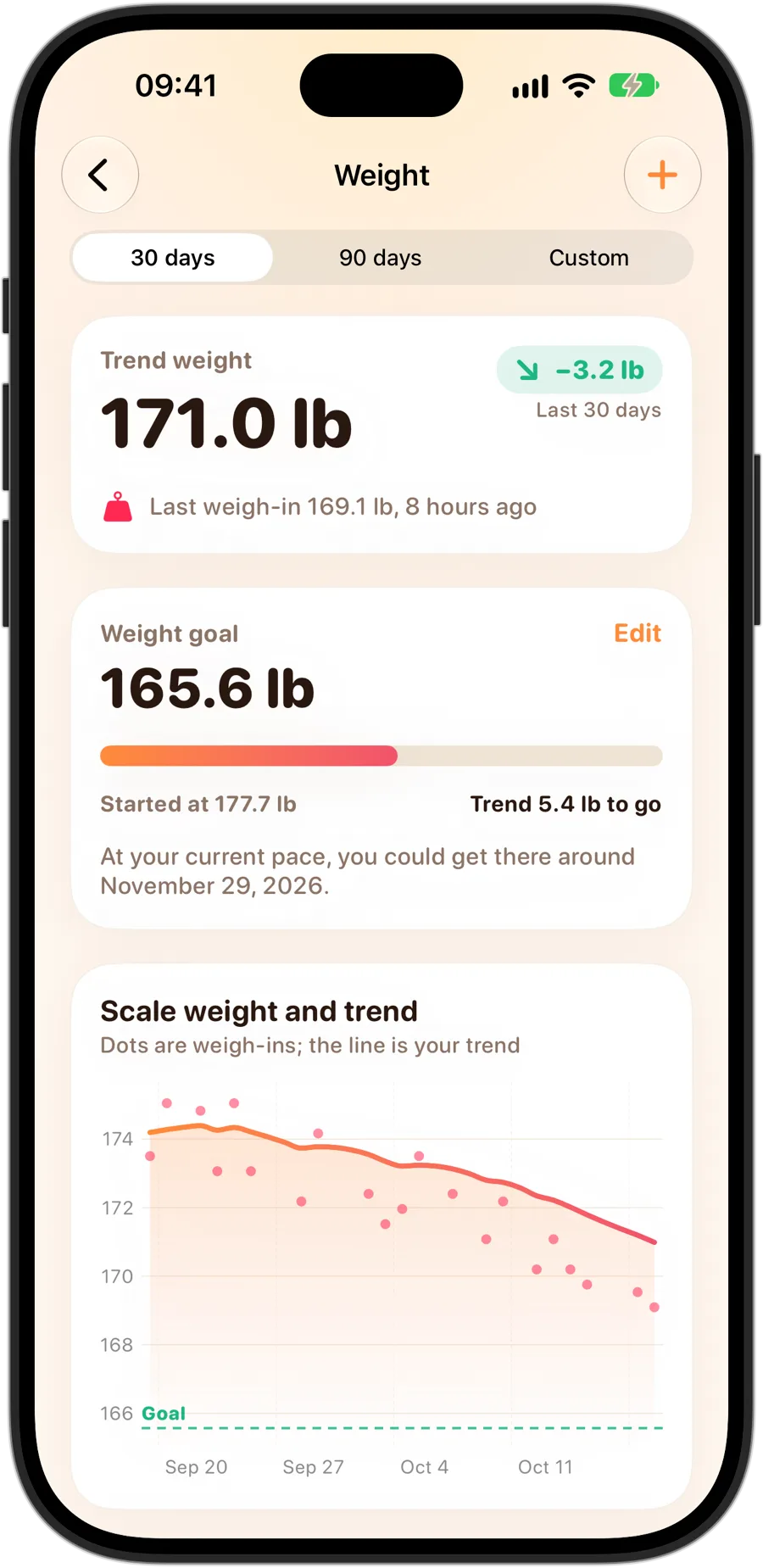
dieting.app is general information, not medical advice. If you are pregnant or breastfeeding, have diabetes, kidney disease or a history of eating disorders, or take medication, talk to your doctor before changing how you eat.