
GUIDES
How to stick to a diet
The diet you keep beats the perfect diet you drop: how habits form, and the ones that help most
Key study
Adherence beat diet type
- Randomized trial
- 160 adults
- 1 year
On four very different diets, average weight loss was similar, and the people who followed their diet most closely lost the most, whichever diet it was.
How habits form
Key study
About 66 days to become automatic
- Observational study
- 96 volunteers
- 12 weeks
Volunteers chose a new eating, drinking or exercise habit and did it daily in the same situation. On average it took 66 days for the habit to feel automatic, but the range was huge, from 18 to 254 days. Missing a single day didn’t affect the process.
The lesson from this study, published in the European Journal of Social Psychology, is practical: tie your new habit to a fixed moment (after breakfast, when you get home), keep it small at first, and expect it to take two months or more before it runs on autopilot.
Eight habits that help
Eight habits
- Eat protein at every meal: it keeps you full for longer 4, and in a feeding study it cut intake by about 440 calories a day without effort 5.
- Choose mostly whole, unprocessed foods. In a careful trial, people offered ultra-processed meals ate about 500 more calories a day than when offered unprocessed meals, and gained weight 6.
- Set a daily eating window, so you know when the kitchen is closed.
- Track something simple: in a review of 22 studies, people who tracked their food, exercise or weight consistently lost more 3.
- Get support: in a two-year trial, people who went to more counseling sessions lost more weight 7.
- Plan for social meals and holidays instead of avoiding them: decide in advance what you’ll eat.
- Sleep enough: in a sleep study, short nights raised hunger and appetite 8.
- Change your surroundings: keep tempting foods out of sight, and healthy ones ready to eat.
Tracking that works
Tracking keeps you honest, because people tend to underestimate what they eat. In a study in the New England Journal of Medicine, people who said they couldn’t lose weight on a low intake were in fact underreporting their food by about 47% and overreporting their exercise by about 51% 9. You don’t have to track forever: a few weeks of weighing food teaches you portions, and weighing yourself weekly keeps you on course.
When you slip
One off-plan meal doesn’t undo a week, and the habit research found that missing a day didn’t affect habit formation 2. Go back to your next planned meal as if nothing happened. Looking at your weight trend over weeks, not days, keeps a bad day in proportion.
When progress stalls
Stalls are normal: water shifts can hide fat loss for a week or two, and your maintenance calories drop as you lose weight 10. Before cutting more, check your portions for a week and recalculate with the calculator.
Myths and facts
Myth Missing one day ruins your progress.
Fact In the habit study, a single missed day made no difference 2. What matters is what you do most days.
Myth Strict diets work better.
Fact In a year-long trial, the strictest diets had the most dropouts, and people who stuck with any diet did best 1.
Let an app keep count
Questions
How long does it take for a diet to become a habit?
In one study, a median of 66 days, but anywhere from 18 to 254 2. Keep the rules simple so they need less willpower while they settle.
What if I hate my diet?
Change it. For weight loss, most diets work about as well as each other, so pick one you enjoy 1.
Sources
- Dansinger ML, Gleason JA, Griffith JL, et al. Comparison of the Atkins, Ornish, Weight Watchers, and Zone Diets for Weight Loss and Heart Disease Risk Reduction: A Randomized Trial. JAMA. 2005;293(1):43-53. doi.org/10.1001/jama.293.1.43
- Lally P, van Jaarsveld CHM, Potts HWW, Wardle J. How are habits formed: Modelling habit formation in the real world. Eur J Soc Psychol. 2010;40(6):998-1009. doi.org/10.1002/ejsp.674
- Burke LE, Wang J, Sevick MA. Self-Monitoring in Weight Loss: A Systematic Review of the Literature. J Am Diet Assoc. 2011;111(1):92-102. doi.org/10.1016/j.jada.2010.10.008
- Leidy HJ, Clifton PM, Astrup A, et al. The role of protein in weight loss and maintenance. Am J Clin Nutr. 2015;101(6):1320S-1329S. doi.org/10.3945/ajcn.114.084038
- Weigle DS, Breen PA, Matthys CC, et al. A high-protein diet induces sustained reductions in appetite, ad libitum caloric intake, and body weight despite compensatory changes in diurnal plasma leptin and ghrelin concentrations. Am J Clin Nutr. 2005;82(1):41-48. doi.org/10.1093/ajcn/82.1.41
- Hall KD, Ayuketah A, Brychta R, et al. Ultra-Processed Diets Cause Excess Calorie Intake and Weight Gain: An Inpatient Randomized Controlled Trial of Ad Libitum Food Intake. Cell Metab. 2019;30(1):67-77.e3. doi.org/10.1016/j.cmet.2019.05.008
- Sacks FM, Bray GA, Carey VJ, et al. Comparison of Weight-Loss Diets with Different Compositions of Fat, Protein, and Carbohydrates. N Engl J Med. 2009;360(9):859-873. doi.org/10.1056/NEJMoa0804748
- Spiegel K, Tasali E, Penev P, et al. Brief communication: Sleep curtailment in healthy young men is associated with decreased leptin levels, elevated ghrelin levels, and increased hunger and appetite. Ann Intern Med. 2004;141(11):846-50. doi.org/10.7326/0003-4819-141-11-200412070-00008
- Lichtman SW, Pisarska K, Berman ER, et al. Discrepancy between Self-Reported and Actual Caloric Intake and Exercise in Obese Subjects. N Engl J Med. 1992;327(27):1893-1898. doi.org/10.1056/NEJM199212313272701
- Hall KD, Sacks G, Chandramohan D, et al. Quantification of the effect of energy imbalance on bodyweight. Lancet. 2011;378(9793):826-837. doi.org/10.1016/S0140-6736(11)60812-X
MAKE IT A HABIT
Any diet.
Your eating window.
Fasting Tracker is a free intermittent fasting app for iPhone, iPad and Apple Watch.
Download Fasting Tracker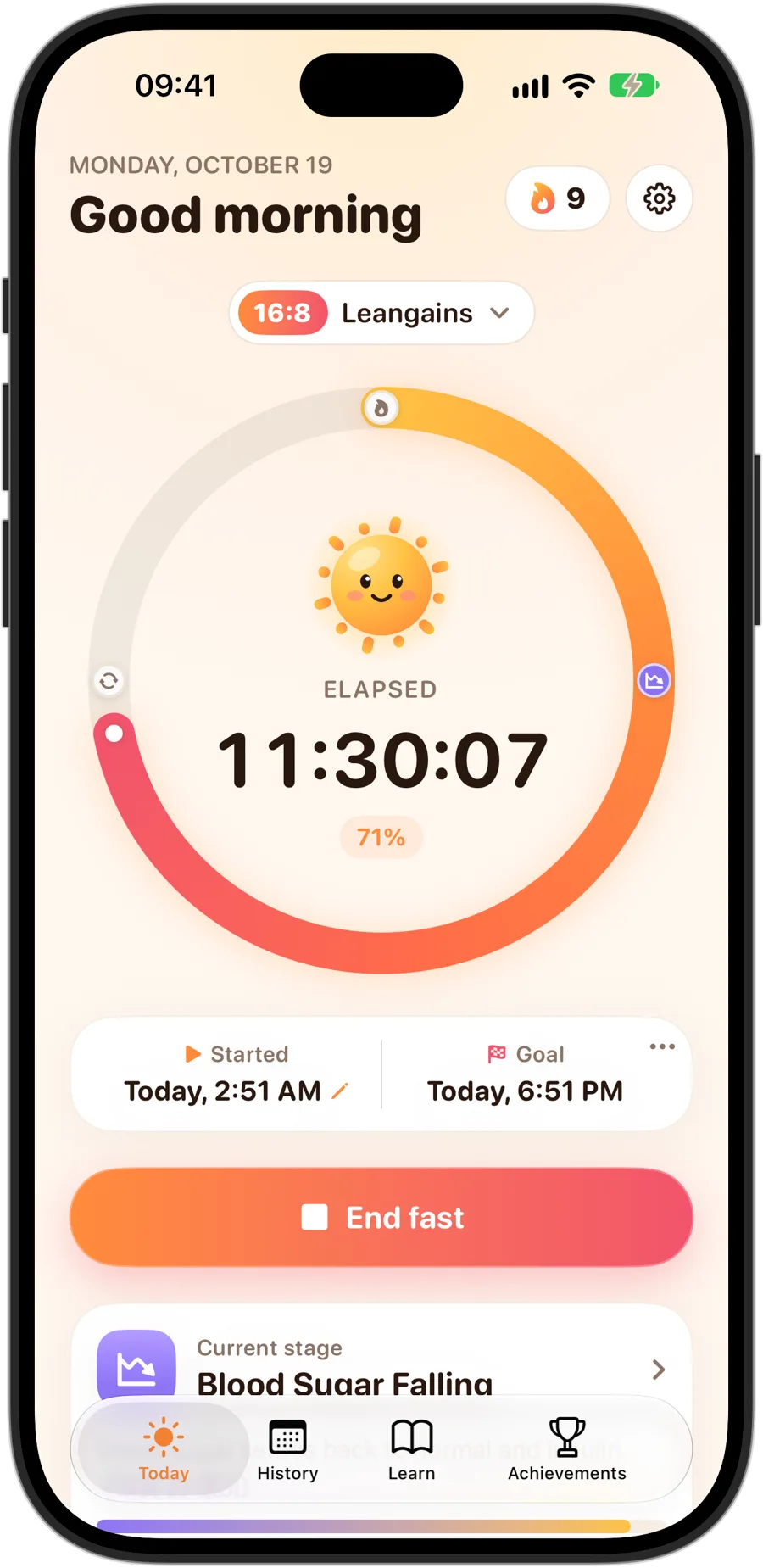
dieting.app is general information, not medical advice. If you are pregnant or breastfeeding, have diabetes, kidney disease or a history of eating disorders, or take medication, talk to your doctor before changing how you eat.