
GUIDES
How to keep weight off
Why weight comes back, how often it doesn’t, and the habits of people who keep it off for years
How often weight comes back
Key study
Five years later
- Meta-analysis
- 29 US studies
- 5 years
After structured weight-loss programs, people had kept off about 3 kg, about 23% of what they had lost, five years later. Those who lost more at first kept off more.
Key study
Eight years later, half kept 5% off
- Randomized trial
- 5,145 adults with type 2 diabetes
- 8 years
In the Look AHEAD trial, people in an intensive lifestyle program had lost 4.7% of their weight after eight years, compared with 2.1% in the comparison group. Half of the lifestyle group still weighed at least 5% less than at the start, and over a quarter at least 10% less.
So some regain is common, but losing weight for good isn’t rare. A 5% loss, such as 4 kg from 80 kg, is enough to improve blood pressure, blood sugar and cholesterol for many people.
Why weight comes back
Key study
Appetite stays higher
- Clinical study
- 50 adults with overweight
- 62 weeks
A year after a 10-week diet, the hormones that signal hunger and fullness were still changed in the direction that increases appetite, and people felt hungrier than before.
Your body also needs fewer calories at a lower weight, so eating as you did before your diet leads to regain 4. After very fast, extreme weight loss, the drop in energy use can be larger and last for years 6. None of this is a lack of willpower: it’s biology, and it can be managed.
What successful people do
Key study
Thousands who kept it off
- Registry study
- Over 4,000 adults
- Kept off for years
The US National Weight Control Registry follows people who lost at least 13.6 kg (30 lb) and kept it off for at least a year; on average they had lost about 33 kg and kept it off for more than 5 years. Most stayed very active, about an hour a day, ate a lower-calorie diet consistently on weekdays and weekends, ate breakfast, weighed themselves regularly and caught small regains early.
- Stay active every day: walking counts, and most registry members did about an hour a day 5.
- Eat consistently: similar meals and rhythm on weekdays and weekends.
- Weigh yourself at least weekly, and act on small regains before they grow.
- Keep your protein high: it helps control appetite 7.
- Keep the habits that worked, such as your eating window, even if you relax them a little.
Your maintenance plan
Five steps
- Recalculate your maintenance calories at your new weight with the calculator.
- Add back about 100 to 200 calories a day at a time, and watch your weight for two weeks.
- Keep your protein high and your meals regular.
- Set a range, for example 1 kg (2 lb) either side of your goal, and act when you go above it.
- Stay active every day.
Myths and facts
Myth Almost everyone regains all the weight.
Fact Regain is common, but in Look AHEAD half of the lifestyle group kept at least 5% off after eight years 2.
Myth Once you reach your goal, you can eat as before.
Fact Your maintenance at a lower weight is lower than before, so old portions lead to regain 4.
Let an app watch your range
Questions
Is it normal to regain some weight?
A little regain is common, especially right after a diet, partly water and food in your gut. Act on the trend over weeks, not single weigh-ins.
How many calories should I eat to maintain?
Roughly your new maintenance, which the calculator estimates. Adjust by how your weight behaves over a few weeks.
Does exercise help keep weight off?
It’s one of the most common habits of people who keep weight off for years 5, and it helps protect muscle.
Sources
- Anderson JW, Konz EC, Frederich RC, Wood CL. Long-term weight-loss maintenance: a meta-analysis of US studies. Am J Clin Nutr. 2001;74(5):579-584. doi.org/10.1093/ajcn/74.5.579
- Look AHEAD Research Group. Eight-year weight losses with an intensive lifestyle intervention: the Look AHEAD study. Obesity (Silver Spring). 2014;22(1):5-13. doi.org/10.1002/oby.20662
- Sumithran P, Prendergast LA, Delbridge E, et al. Long-Term Persistence of Hormonal Adaptations to Weight Loss. N Engl J Med. 2011;365(17):1597-1604. doi.org/10.1056/NEJMoa1105816
- Hall KD, Sacks G, Chandramohan D, et al. Quantification of the effect of energy imbalance on bodyweight. Lancet. 2011;378(9793):826-837. doi.org/10.1016/S0140-6736(11)60812-X
- Wing RR, Phelan S. Long-term weight loss maintenance. Am J Clin Nutr. 2005;82(1 Suppl):222S-225S. doi.org/10.1093/ajcn/82.1.222S
- Fothergill E, Guo J, Howard L, et al. Persistent metabolic adaptation 6 years after “The Biggest Loser” competition. Obesity (Silver Spring). 2016;24(8):1612-1619. doi.org/10.1002/oby.21538
- Leidy HJ, Clifton PM, Astrup A, et al. The role of protein in weight loss and maintenance. Am J Clin Nutr. 2015;101(6):1320S-1329S. doi.org/10.3945/ajcn.114.084038
MAKE IT A HABIT
Any diet.
Your eating window.
Fasting Tracker is a free intermittent fasting app for iPhone, iPad and Apple Watch.
Download Fasting Tracker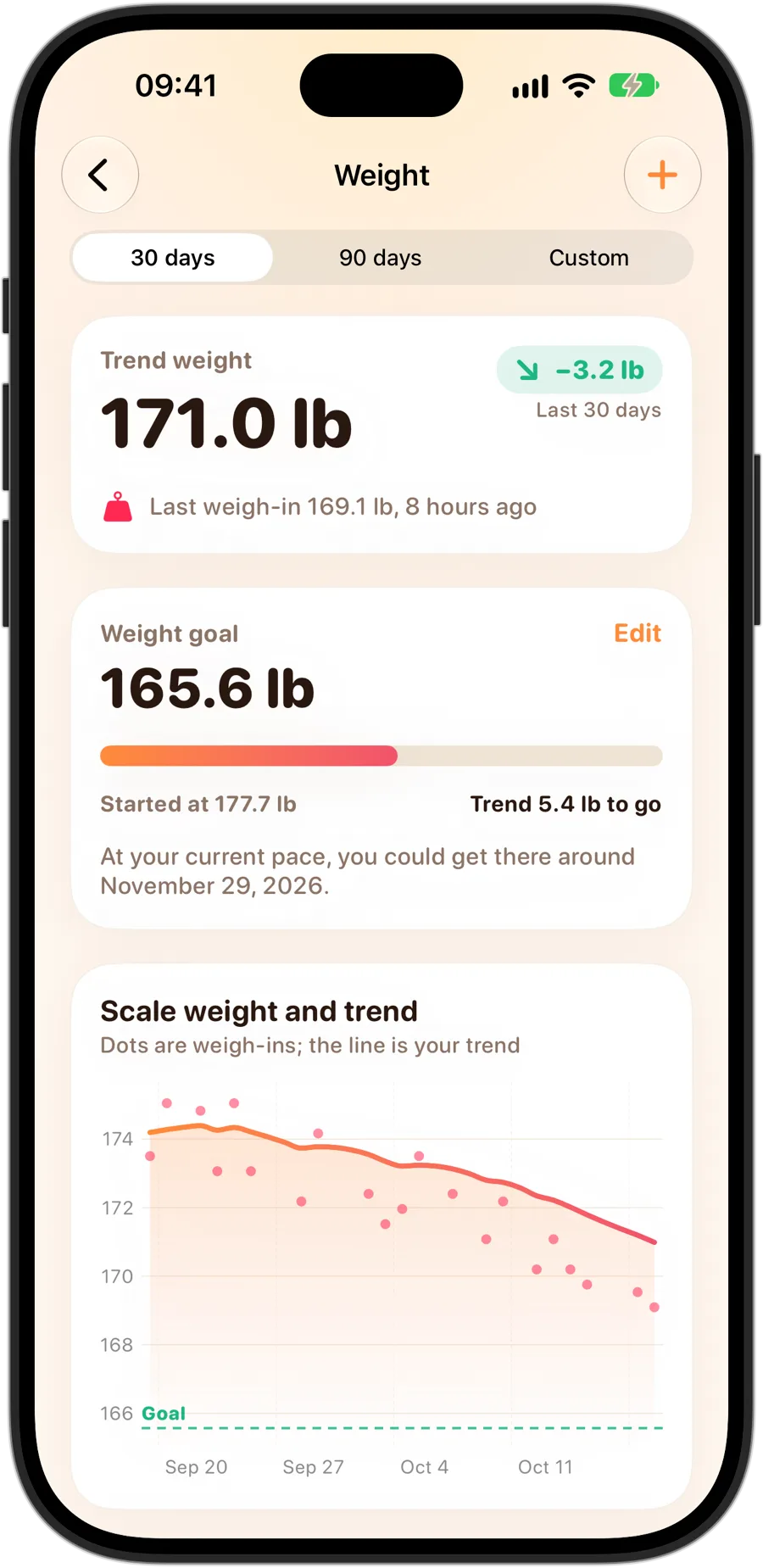
dieting.app is general information, not medical advice. If you are pregnant or breastfeeding, have diabetes, kidney disease or a history of eating disorders, or take medication, talk to your doctor before changing how you eat.